
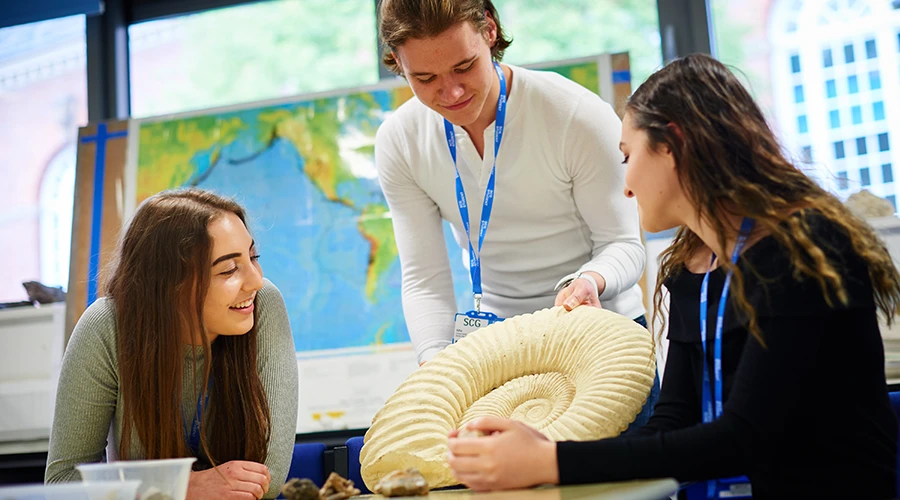
Geology is the science of our planet’s past, present and future. By studying it, you will gain the tools to decode Earth’s 4.5 billion year history and understand the forces that continue to shape our world today. Think of yourself as a planetary detective, uncovering where vital resources such as minerals, metals and water are found, exploring how life has evolved, and investigating how Earth might respond to a rapidly changing climate.
Rocks act as Earth’s storybooks, preserving evidence of ancient oceans, vanished landscapes and extinct life forms. Through Geology, you’ll learn how to read these stories and apply them to the challenges society faces now and in the future.
As a hands-on science, Geology takes you beyond the classroom. Over the two-year course, you will take part in five fieldwork experiences, giving you the chance to observe real geological processes and develop practical skills essential for further study and careers in the Earth sciences.
If you are eager to tackle the environmental and resource challenges of tomorrow, Geology offers a powerful way to make sense of the world - and your role in shaping its future. As Sir David Attenborough reminds us, humanity now holds extraordinary influence over the planet, and with that comes a profound responsibility to safeguard the future of all life on Earth.
-
Entry Requirements
A minimum of five GCSEs at grade 4 or above, including English Language, Maths and either Chemistry or Physics or grade 4:4 or above in Combined Science. There is no requirement to have studied Geology at GCSE, but you should have an interest in science, the natural world, the Earth, and enjoy practical and outdoor work.
-
What does the course involve?
In the first year, you will build the essential foundations needed to interpret the stories preserved within rocks, minerals and fossils. You will explore:
- How minerals and rocks form
- Earth’s internal structure and the processes of plate tectonics
- Invertebrate fossils and what they reveal about ancient life
- Rock deformation and the forces that shape landscapes
In the second year, you will apply this knowledge to real-world challenges facing society today and in the future. Key themes include:
- Energy, water and metal resources – where they come from and how we secure them sustainably.
- Engineering geology – from waste disposal and tunnel construction to road design and slope stability.
- Geohazards – understanding earthquakes, tsunamis, volcanic eruptions and landslides.
- The evolution of vertebrates – including amphibians, reptiles, dinosaurs and birds.
- Climate change and human evolution – exploring how the past helps us understand potential futures.
-
How is the course assessed?
100% exam, together with 20 required practical investigations over two years, leading to a pass in the practical endorsement.
-
Additional Notes
Many students progress to degrees in geology, palaeontology, environmental science, geography, marine biology, oceanography and engineering.
These can lead to careers in hydrogeology, oceanography, environmental geochemistry, palaeontology, geomorphology, volcanology, geohazard mitigation, engineering geology and many more. Some of the career options that geology can offer involve travelling the world.
-
Further Information
Fieldwork is an integral part of the course and involves the following opportunities:
- Wren's Nest Day Trip (Mandatory)
- Five-day trip to the Isle of Arran (Mandatory)
- Earth Science Centre Day Trip (Optional)
- Five-day trip to Iceland (Optional)
- Natural History Museum London Day Trip (Optional).
-
What do I do next?
You can apply online via the APPLY button and then add an additional two or three subjects to make up your academic programme. You can also apply for a second, alternative vocational programme of study via a separate application. If after reading this factsheet, you are still undecided about the course most suitable for you, please drop into one of our open evenings, ring our Admissions Department on 01743 653111, or email admissions@scg.ac.uk